Freedom of Expression and Religion

The First Amendment to the U.S. Constitution creates a bedrock for American values, guaranteeing freedom of expression and assembly, a free press, and our freedom to practice our faith or no faith at all. Our work defending protected speech and religious freedom in Nebraska has taken us to communities large and small. We firmly believe that constitutional rights must apply to even the most unpopular groups if they're going to be preserved for everyone.
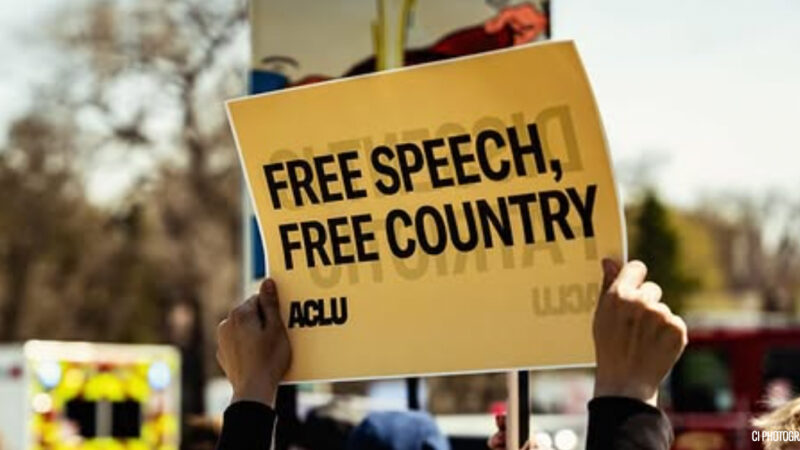
A rally attendee in Omaha holds an ACLU sign reading "FREE SPEECH, FREE COUNTRY."

What you need to know

3 of 4

According to Pew Research Center, about three out of every four Nebraskans identify as religious. Common faiths include Christianity, Islam, Buddhism, Unitarian Universalism, Judaism, Hinduism and traditional Native religions.

125

Omaha Police arrested 125 protesters during one of the 2020 George Floyd protests. Police actions gave rise to our ProBlac v City of Omaha lawsuit, which ended successfully with a settlement.

2025

As of July 2025, school dress codes are required to better respect students' right to religious attire and characteristics associated with religion. State law names that this includes, but is not limited to, items such as burkas, hijabs and tribal regalia.

As enshrined in the First Amendment, religious freedom includes two complementary protections: the right to religious belief and expression and a guarantee that the government neither prefers religion over non-religion nor favors particular faiths over others. These dual protections work hand in hand, allowing religious liberty to thrive and safeguarding both religion and government from the undue influences of the other. In Lincoln, we have taken the case of a 77 year old Nebraska veteran and grandfather who was criminally cited for peacefully expressing his religious view in the public square.

Freedom of speech, the press, association, assembly, and petition: This set of guarantees, protected by the First Amendment, comprises what we refer to as freedom of expression. It is the foundation of a vibrant democracy, and without it, other fundamental rights, like the right to vote, would wither away. In greater Nebraska we have successfully defended the right of citizens who were threatened with prosecution for publicly criticizing local government officials.

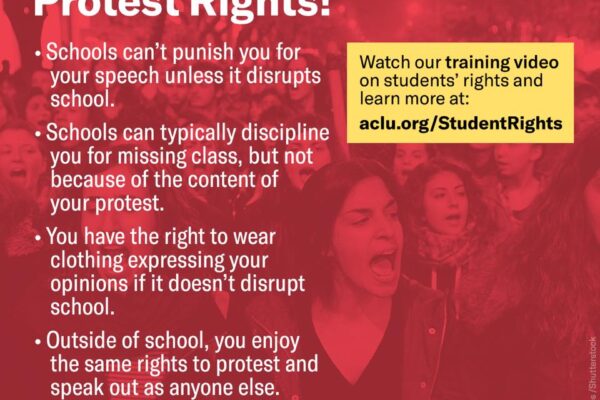
Speech on campus has often been the epicenter of modern conversations on the First Amendment. Nebraska's students have the right to speak their mind on social media and to run school newspapers free of undue censorship. We monitor 151 public school districts in Nebraska for violations of free speech.

Learn more about the ACLU's work to defend campus speech

Read ACLU testimony on campus speech legislation


The Latest
News & Commentary
Student Rights Square - aclu.org/studentrights

Open Letter to Nebraska Superintendents on Student Walkouts

March 13, 2018
Press Release
Placeholder image

ACLU Warns Elected Officials, Government Agencies, Against Blocking Members of Public on Social Media
News & Commentary
Text: The last year was a relentless attack on civil rights and civil liberties. Nevertheless, we persisted, we resisted, & we achieved important progress. Thank you.

Thanks to you - 2017 Victory List

The last year was a relentless attack on civil rights and civil liberties emanating from the highest echelons of political power and emboldening state and local leaders to act in ways previously unimaginable. Nevertheless, we persisted, we resisted, and we achieved important progress.
Press Release
Placeholder image

ACLU Statement on Proposed Revisions to Omaha Panhandling Ordinance

Court Case
Aug 31, 2022

Eggers v. Evnen

Crista Eggers tried for years to qualify a ballot initiative to de-penalize the use and possession of medical cannabis. As Eggers and Nebraskans for Medical Marijuana sought to qualify for the ballot in 2022, they turned to the ACLU of Nebraska for help challenging a provision of the state constitution that requires a certain threshold of signatures from 38 counties to qualify for the statewide ballot. Eggers v. Evnen argued current law treats ballot signatures as unequal based on geography, violating the principle of “one person, one vote” that’s protected under the 14th Amendment.  For example, a single Douglas County voter has less than a thousandth of the power of an Arthur County voter in determining whether their county meets its signature threshold. A district court judge initially issued an order temporarily blocking the enforcement of this provision. A month later, however, the U.S. 8th Circuit Court of Appeals issued a stay on the earlier order, effectively overturning it and upholding the ballot qualification requirement. Our litigation ended with a split decision in the U.S. 8th Circuit Court of Appeals that keeps the rule in place on the basis that our equal protection argument did not apply to state ballot initiative processes. One dissenting judge noted that “if the right to vote is fundamental, I see no reason why it should not apply equally to the initiative process at the heart of Nebraska’s electoral and legislative system.”
Court Case
Oct 16, 2023

Pennell & Nebraska High School Press Association v. Northwest Public Schools

Marcus Pennell, then a senior at Northwest Public High School, was a student reporter for the school’s newspaper called the Viking Saga. In the paper’s June 2022 issue, Pennell wrote an editorial on the Florida Parental Rights in Education Act, or what’s been popularly called the ‘Don’t Say Gay’ law, discussing the history of LGBTQ+ rights and the harm of erasure. Days after publication, the school shuttered the newspaper and terminated its newspaper class. We launched a lawsuit against Grand Island Northwest Public Schools on behalf of the Nebraska High School Press Association and student journalist Marcus Pennell for claims that school officials shut down the school newspaper for publishing articles on LGBTQ+ topics. Our lawsuit argued that school officials’ decision to shutter the newspaper violated the plaintiffs’ First Amendment free speech rights on three counts: their right to be free of viewpoint discrimination, their right to be free of retaliation and their right to receive information. The case was unfortunately dismissed because Pennell was no longer a current student, but the judge noted “school administrators would be wise to remember that policies and decisions to restrict speech in student newspapers [...] may run afoul of the First Amendment if they reflect ‘an effort to suppress expression merely because public officials oppose a speaker’s view.’”
Court Case
Mar 12, 2015

Ball v. City of Lincoln