

Tiala Luong walked with pride at her South Sioux City High School graduation — pride in her culture, heritage, academic accomplishments and self-advocacy. Luong, who is an enrolled member of the Winnebago Tribe and of Ho-Chunk, Omaha and Santee Sioux descent, made headlines by sticking up for her right to wear tribal regalia at graduation after a school administrator initially told her no.
Her journey to walking across the stage in regalia began through a conversation with a recent graduate who is also Native American.

South Sioux City's class of 2026 gathers at a May graduation ceremony.
Jerry Mennenga for the ACLU of Nebraska
“They said I would get a cap to decorate and then one I cannot decorate. And I would wear the non-decorated one across the stage,” Luong said. “That didn't sit right with me. It left a bad taste in my mouth.”
She sat on it, researched new state laws protecting students’ right to wear tribal regalia at school functions, and eventually went straight to the school’s principal.
“Sometimes the most uncomfortable conversations need to be had because those are the most important ones,” she said. “I told him how much it mattered to me, how much it meant to me, my family, my culture. And I told him pretty much, I just laid it out like, ‘Hey, you can't do this. It's against the law. Like, you need to let me do that.’ And he said, no.”
A week or two later, Luong said, the principal called her back into his office to share that his answer had changed. Luong and other Indigenous students would be permitted to wear regalia in the spring ceremony.
“As we dug into this more, we realized, number 1, this is what’s right for our population of students. And, also, this is a law, and our district is going to support that law,” Principal David Clausen told KTIV.
“I said, ‘Oh, so I swayed your opinion?’ Because I was really adamant on did I do something,” Luong said. “Like did I do it? And he said, ‘Yes, you did.’”

Luong walks to receive her diploma.
Jerry Mennenga for the ACLU of Nebraska
Luong walked with pride in a gown with ribbons and a beaded cap that was adorned with a feather gifted by a tribal elder and a plume gifted by the family friend who had beaded the cap. The full power of that moment, she said, did not hit her until later when she was talking with her great grandfather about other family members’ experiences and the struggles some faced graduating or graduating on time.
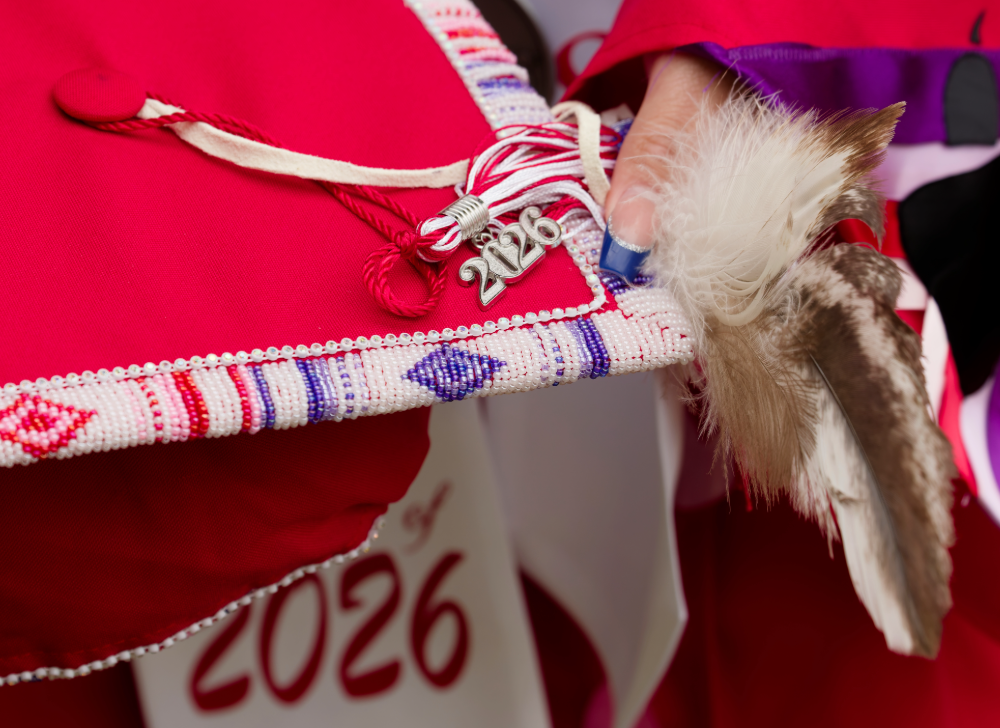
A close-up image shows the beading on Luong's cap.
Jerry Mennenga for the ACLU of Nebraska
“Some people don’t understand,” Luong said. “We beat so many systems that were created to erase us. We faced oppression, ethnic cleansing, cultural genocide.” Luong points to Indigenous boarding schools as an example, which separated thousands of Indigenous children from their families. Nebraska’s Genoa Boarding School operated until 1934. “We survived generational trauma. All those were created to erase us. And we're still here, we're graduating, and we should be proud.”
Luong plans to pursue a degree and study Indigenous cultures and history. She hopes that Indigenous students see her story, know their rights and feel empowered.

Luong rejoins her classmates after receiving her diploma.
Jerry Mennenga for the ACLU of Nebraska
“We have so much to be proud of, but it feels like sometimes people just like try to silence us, try to only acknowledge it when it's convenient for others. And I can't stand behind that because we matter just as much as anyone else does, and especially our youth. We need to stand strong because our ancestors laid down their lives for us to be here today.”
“We need to be proud and we need to stand on it and stand on 10 toes, because that's what they would want for us.