New Bills Seek Increased Accountability for ICE, Law Enforcement
January 8, 2026 12:50 pm
Today, Nebraska lawmakers introduced a series of bills seeking to increase accountability for immigration authorities and law enforcement officers working in Nebraska.
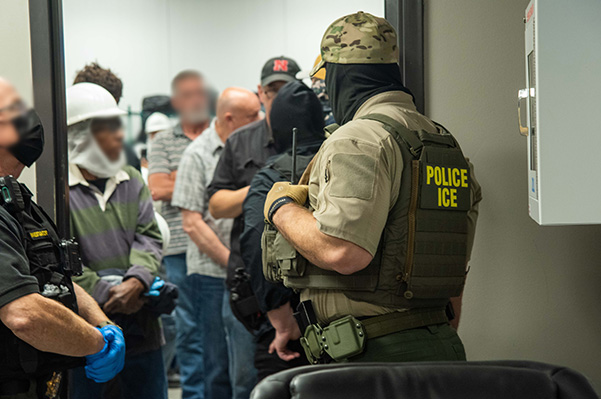
- State Sen. Megan Hunt introduced LB 854 and State Sens. Margo Juarez, Dunixi Guereca, Terrell McKinney, Victor Rountree, and Ashlei Spivey introduced LB 906. Both bills aim to increase accountability and support community safety by requiring law enforcement officers and federal agents working in Nebraska to keep their faces visible and wear identification. Their requirements broadly cover most interactions between the public and local and federal officers and agents. They include exemptions for undercover activities and situations when a face shield, helmet or respirator is needed for physical safety. The bills follow a year of high-profile immigration enforcement activities involving U.S. Immigration and Customs Enforcement (ICE) agents wearing ski masks, bandanas and other face coverings. For example, women taken in an Omaha raid that involved masked agents told the Omaha World-Herald some agents treated them with force, mocked them, and told them they “didn’t deserve rights”; ICE denies that happened.
- State Sens. Guereca and Juarez introduced LB 881, a bill that would require advance public notice and a vote of a local governing body before law enforcement agencies and jails enter into immigration enforcement agreements under the federal 287(g) program. The bill also includes reporting requirements to ensure compliance. The bill comes as partnerships with ICE have grown under the second Trump administration. Prior to 2025, only the Dakota County Sheriff’s Department was participating in the 287(g) program. Today, four Nebraska counties, the Nebraska State Patrol (NSP) and the Nebraska Department of Correctional Services (NDCS) have active agreements. The NDCS agreement facilitated the repurposing of a minimum-security prison in McCook into an immigrant detention center at Gov. Jim Pillen’s direction.
- State Sens. Juarez, Conrad, Guereca, McKinney, Quick, Rountree, and Spivey introduced LB 907, preventing immigration enforcement in certain designated community spaces unless an emergency exists or a valid judicial warrant is presented. Some of those locations include medical facilities, schools, libraries, courthouses, shelters, churches, and child care facilities.
ACLU of Nebraska Staff Attorney Jamel J.W. Connor made this statement on the mask bills, LB 854 and LB 906:
“The growing presence of masked agents in our communities creates fear, not safety. It undermines public trust, increases risk of confusion, invites impersonation attempts and hurts officer accountability. These bills offer a smart way to address something that is understandably contributing to mistrust and making our communities less safe. We are grateful for senators listening to their constituents’ concerns and bringing solutions forward.”
Connor made this statement on the 287(g) bill, LB 881:
“This bill does not prevent 287(g) agreements, it just requires transparency and accountability. Nebraskans deserve to know when local officials are considering an agreement that can undermine public trust and shift focus away from public safety efforts. If officials want to use their time and resources on immigration enforcement, they should be prepared to explain the consequences and the civil rights implications to their communities. It is as simple as that.”
Connor made this statement on the community safe spaces bill, LB 907:
“People should not have to fear going to school, complying with court orders, seeking medical care or worshiping with their congregation. Limiting enforcement activities in schools, hospitals, churches and other important locations like domestic violence shelters benefits us all by ensuring our loved ones and neighbors can continue to seek care, support and education with peace of mind. ICE’s new practice allowing immigration enforcement in sensitive locations has not made our communities safer; this bill will.”
Stay Informed
Sign up to be the first to hear about how to take action.
By completing this form, I agree to receive occasional emails per the terms of the ACLU’s privacy statement.
By completing this form, I agree to receive occasional emails per the terms of the ACLU’s privacy statement.