New Campaign Aims to Inform, Empower Nebraska Voters
October 1, 2026 10:00 am
LINCOLN, Neb. – The American Civil Liberties Union (ACLU) of Nebraska is teaming up with organizations from across the state this October through a new nonpartisan campaign meant to inform and empower eligible Nebraska voters who may face barriers to the polls.
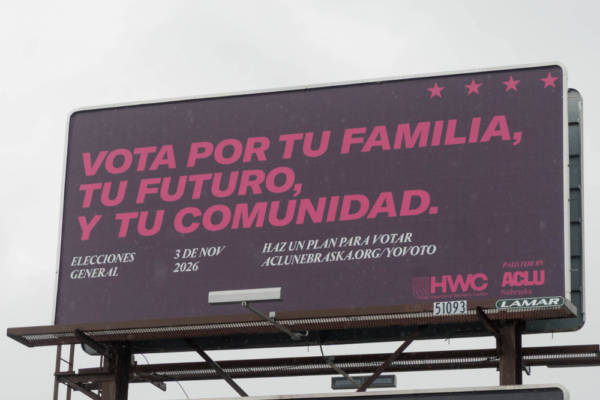
Spanish-speaking voters, voters with past felony convictions, and Indigenous voters who may not know that their tribal ID meets Nebraska’s photo ID requirement are some of the Nebraskans who will benefit from messages they will see in their mailboxes, on billboards and in digital and broadcast ads this fall.
The ad blitz is designed to complement nonpartisan canvassing and community engagement efforts led by partners on this project, including Common Cause of Nebraska, Great Plains Action Society, Heartland Workers Center, Multicultural Coalition – Grand Island, the Nebraska Civic Engagement Table and RISE.
Most ads point voters toward the English or Spanish version of the ACLU of Nebraska’s website, where the civil rights organization outlines key voting dates and answers questions about topics ranging from the laws around language access to how voters facing homelessness can vote. Some ads also direct voters to a webpage that explains the judicial retention process and summarizes the Nebraska State Bar Association’s survey of attorneys who have practiced before the judges who are up for retention.
The ACLU of Nebraska and partners hope the outreach leads to more participation. Nebraska’s turnout is significantly lower in midterms than in presidential years. Campaign messages encourage Nebraskans to cast informed votes and participate for their families, futures and communities.
Mindy Rush Chipman, executive director of the ACLU of Nebraska, said:
“There is no question that some eligible Nebraskans are sitting out of elections because they do not understand their eligibility, the process or the power of their vote. Those barriers should never stop someone from having a say on decisions that will impact our lives and our communities. We tell our supporters to vote like our rights depend on it, because they do. We hope all eligible Nebraskans join their friends and family members by voting in this important election.”
Dr. Lina Traslaviña Stover, executive director of Heartland Workers Center, said:
“When immigrant and working families participate in civic life, our communities are stronger because the people most affected by decisions have a voice in shaping them. Our role at Heartland Workers Center is not to tell people what to think or how to vote, but to make sure they recognize the power they already have, have the information to participate with confidence, and know that their voice belongs in the decisions shaping our schools, workplaces, neighborhoods, and future.”
Tina Rockenbach, director of policy and advocacy for RISE, said:
"RISE is dedicated to breaking generational cycles of incarceration so that all people find freedom from incarceration. Working to remove barriers for individuals who are formerly incarcerated includes barriers to their civic engagement. RISE's efforts in 2024 led to the successful elimination of a two year waiting period once individuals are off papers and their sentence is completed. Restoring an individual's right to vote is indeed integral to their successful reentry into their communities. RISE is dedicated to ensuring all Nebraskans that are justice-impacted can participate in their right to vote by provided information at getmyvoteback.org."
Along with voter education efforts, the ACLU of Nebraska has been supporting collaborative election protection efforts by recruiting and training ballot count watchers and legal observers. The next scheduled training is Tuesday, Oct. 6. Nebraskans who are interested in learning more or registering should visit aclunebraska.org/defend.
Related Issues
Stay Informed
Sign up to be the first to hear about how to take action.
By completing this form, I agree to receive occasional emails per the terms of the ACLU’s privacy statement.
By completing this form, I agree to receive occasional emails per the terms of the ACLU’s privacy statement.