Court Cases
All Cases
2 Court Cases
Oct 16, 2024

State ex rel. Spung v. Evnen
Less than four months before the 2024 presidential election, Nebraska Secretary of State Robert Evnen issued a directive that barred access to the ballot for eligible Nebraskans with past felony convictions.
The directive followed recent progress. Since 2005, Nebraskans with past felony convictions had been legally able to vote two years after completing all terms of their felony sentence. In 2024, the Nebraska Legislature passed a law that removed the two-year wait. Before the law could go into effect, Nebraska Attorney General Mike Hilgers issued a non-binding opinion declaring that only the state Board of Pardons can restore voting rights, putting tens of thousands of voters' rights into question. Evnen used this opinion to unlawfully order officials to refuse to follow the law and refuse to register eligible voters with past felony convictions regardless of how much time had passed their sentence.
The American Civil Liberties Union, the ACLU of Nebraska, and Faegre Drinker LLP filed a petition for a writ of mandamus in the Nebraska Supreme Court, challenging the directive on behalf of affected individuals and Civic Nebraska, a nonpartisan, nonprofit group. On October 16, 2024, the Nebraska Supreme Court issued a writ of mandamus ordering the Secretary of State and election commissioners to follow the law and allow eligible Nebraskans to register and vote.
Aug 31, 2022
Eggers v. Evnen
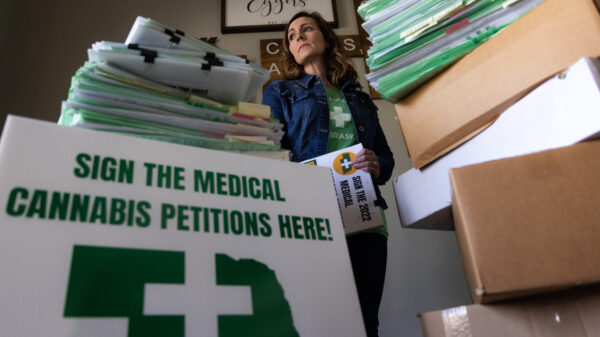
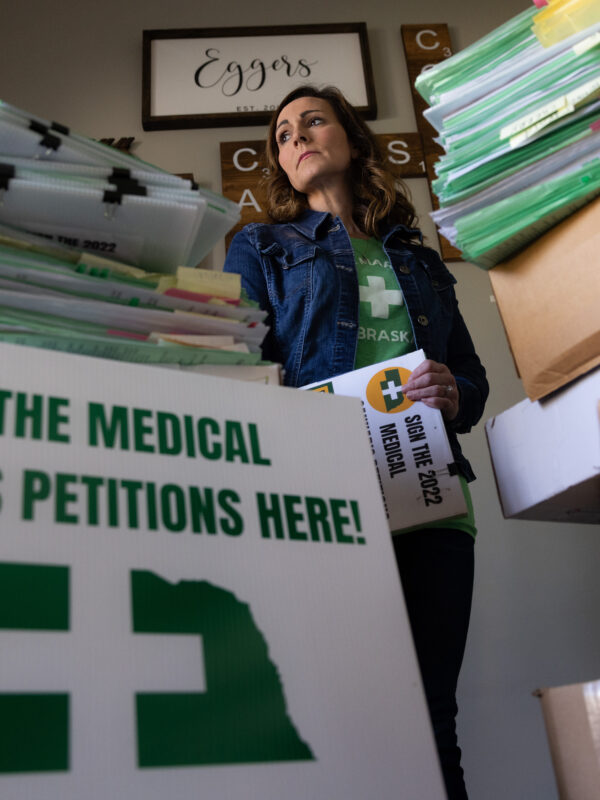
Crista Eggers tried for years to qualify a ballot initiative to de-penalize the use and possession of medical cannabis. As Eggers and Nebraskans for Medical Marijuana sought to qualify for the ballot in 2022, they turned to the ACLU of Nebraska for help challenging a provision of the state constitution that requires a certain threshold of signatures from 38 counties to qualify for the statewide ballot.
Eggers v. Evnen argued current law treats ballot signatures as unequal based on geography, violating the principle of “one person, one vote” that’s protected under the 14th Amendment. For example, a single Douglas County voter has less than a thousandth of the power of an Arthur County voter in determining whether their county meets its signature threshold.
A district court judge initially issued an order temporarily blocking the enforcement of this provision. A month later, however, the U.S. 8th Circuit Court of Appeals issued a stay on the earlier order, effectively overturning it and upholding the ballot qualification requirement.
Our litigation ended with a split decision in the U.S. 8th Circuit Court of Appeals that keeps the rule in place on the basis that our equal protection argument did not apply to state ballot initiative processes. One dissenting judge noted that “if the right to vote is fundamental, I see no reason why it should not apply equally to the initiative process at the heart of Nebraska’s electoral and legislative system.”
Stay Informed
Sign up to be the first to hear about how to take action.
By completing this form, I agree to receive occasional emails per the terms of the ACLU’s privacy statement.
By completing this form, I agree to receive occasional emails per the terms of the ACLU’s privacy statement.